|
Editor - Perry Kinkaide Visit KEInetwork.net |
When Silence Is Strategic – As Power Dissipates
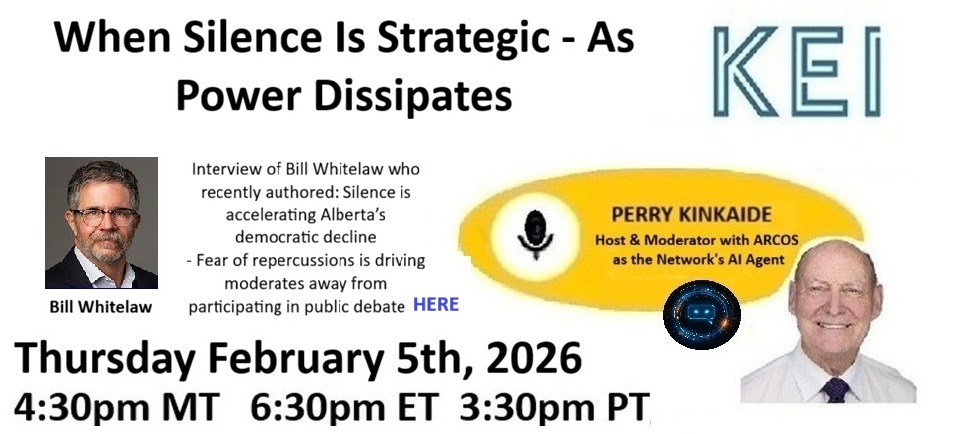
In recent newsletters, I’ve been blunt—perhaps uncomfortably so—about the failure of federal leadership to act on long-standing problems that continue to impede Canada’s development. Those delays are not strategic. They are dangerous. They erode capacity, weaken resilience, and quietly mortgage the future. Waiting, in those cases, is not wisdom; it is neglect dressed up as caution. But silence while waiting imay not be abdication. There are moments when restraint is strategic, when silence is for listening, not passivity but preparation. In an era where every issue is politicized, every disagreement polarized, and every pause interpreted as weakness, the distinction between paralysis and patience has been lost. We are urged to choose sides instantly, to speak loudly, to align reflexively—often before the facts settle or the consequences are understood. This week's webinar and newsletter article - When Silence Is Strategic, examine a largely overlooked source of democratic renewal: the independent, critical thinkers who resist the false binaries of left and right, who conserve judgment in an attention economy that rewards outrage, and who understand that meaningful change is often less about raw power than about timing. These are the listeners in a culture that only values talk, the observers of protest in an age addicted to performance. |
|
Polarization thrives on immediacy. Democracy, by contrast, depends on discernment. The challenge before us is to know when silence is dangerous—when patience is powerful and when to speak up. Your views are welcome, so please consider sending us an article to share and joining our Just Chat webinars any Thursday. Thank you Dennis Pommen for today's Fact or Fiction contribution HERE re-titled - AI Can Be Trusted. - Editor |
|


|
When Silence Is Strategic – As Power Dissipates
Bureaucrats know this well; wait long enough and the status quo will return – except when it doesn’t. Every age flatters itself by believing it is uniquely polarized. Ours, however, has industrialized polarization. Every issue is conscripted. Every question is weaponized. Every pause is treated as complicity. Politics no longer debates outcomes; it sorts identities. Black or white. Left or right. Legal or illegal. For or against. Choose now, speak loudly, and never revise your position. In this environment, the middle is mocked as weakness. The undecided are branded cowards. The patient are told they are late. And listening—true listening—is treated as a luxury we can no longer afford. That is a profound mistake. Continued below
No need to register. Just Zoom in https://us02web.zoom.us/j/84258596166?pw.. Bill Whitelaw is the Executive Director of Rextag in Calgary Alberta. He is a Senior energy executive skilled across a broad base of strategic and operational functions, with a key focus on public policy, government affairs and evolution of the resource sector. HIs experience is complemented by extensive corporate and non-profit board experience. FOR MORE Continued form above Because the most consequential political force of OUR TIME is not shouting. It is watching. Not mobilizing, but waiting. Not power, but timing. There is a growing, largely invisible cohort that does not march, hashtag, or posture. They watch the protesters protest. They listen to the rhetoric harden. They notice how every movement, once righteous, becomes performative; how every cause, once urgent, becomes captured; how outrage decays into habit. They are not apathetic. They are conserving energy.
In physics, wasted motion is friction. In politics, wasted outrage is exhaustion. The loudest voices burn fastest, not brightest. The quiet observers understand something the megaphone class does not: attention is finite, legitimacy is fragile, and credibility compounds slowly. So they wait.
This is not disengagement. It is strategic restraint.
Heuristic Conservation in an Attention Economy. We noted last week that we live in an “attention economy,” an economy of cognitive scarcity. There is too much information, too little signal, and constant pressure to decide before understanding.
The independent critical thinker pushes back by doing something radical: refusing to spend judgment cheaply. Every hot take rejected, every false dichotomy ignored, every demand for instant alignment declined—this is heuristic conservation. It is the deliberate refusal to burn cognitive energy on battles that are premature, misframed, or designed to provoke rather than persuade. Movements don’t usually fail because they are wrong. They fail because they peak too early, spend too fast, and confuse visibility with durability. The watchers understand that democracy is not restored by volume. It is restored by credibility at the moment it matters.
The Myth That Change Comes from Power. Modern politics fetishizes power: who holds it, who loses it, who seizes it next. But history suggests a different pattern. Change rarely comes from raw power alone. Power is noisy. Power attracts resistance. Power invites counter-power.
Enduring change comes from timing. The civil rights movement did not succeed simply because it was loud—it succeeded when moral clarity intersected with institutional vulnerability. The fall of the Berlin Wall was not the triumph of force but of accumulated contradiction. Even markets move not on strength alone, but on inflection points.
The patient observer watches for inflection. They understand that systems rarely collapse when challenged head-on. They collapse when they can no longer justify themselves—to courts, to markets, to citizens, or to their own administrators. That moment cannot be forced. It can only be recognized.
Listening as a Democratic Act. Talk is free. Listening is rare. And because it is rare, it is powerful. Listening does not mean agreeing. It means collecting evidence. Looking beyond the superficial for purpose, intent. Not fooled by performance. It means understanding not just what people say, or even how they say it, but why they say it, and what they are afraid of losing. It means noticing which arguments repeat because they are true—and which repeat because they are convenient.
Democracies do not die from disagreement. They die when no one is listening anymore. The watchers listen across camps. They hear the excesses of both sides. They detect when language drifts from persuasion to coercion, from conviction to contempt. They notice when institutions stop explaining themselves and start demanding loyalty instead. This listening creates something dangerous to polarized systems: legitimacy without alignment.
The Power Yet to Be Expressed. The paradox of OUR MOMENT is this: the largest political bloc in many democracies is not left or right, but exhausted, skeptical, and unconvinced. They are under-organized precisely because they are under-estimated. But history suggests they matter most when the noise burns out.
That is when the listeners speak—and when they do, they are heard. Not because they shout louder, but because they waited longer. The future of democracy may not belong to the angriest voices or the fastest mobilizers. It may belong to those who refused to be rushed, who treated judgment as a scarce resource, and who understood that the most revolutionary act in a polarized age is not to pick a side too soon—but to be ready when the moment finally arrives.
Change is not about power. It is about timing. And the watchers are still watching.
|

|
VISIT KEI Network Help sustain KEI's contributions |
KEI Network PATRONS  Bruce Clark
PROBUS of Central Edmonton
Edmonton Sunrise Rotary Club
|